
If you’re considering commercial solar panels in Lancashire, one of the first questions you’ll probably ask is:
Can my commercial roof actually support a solar installation?
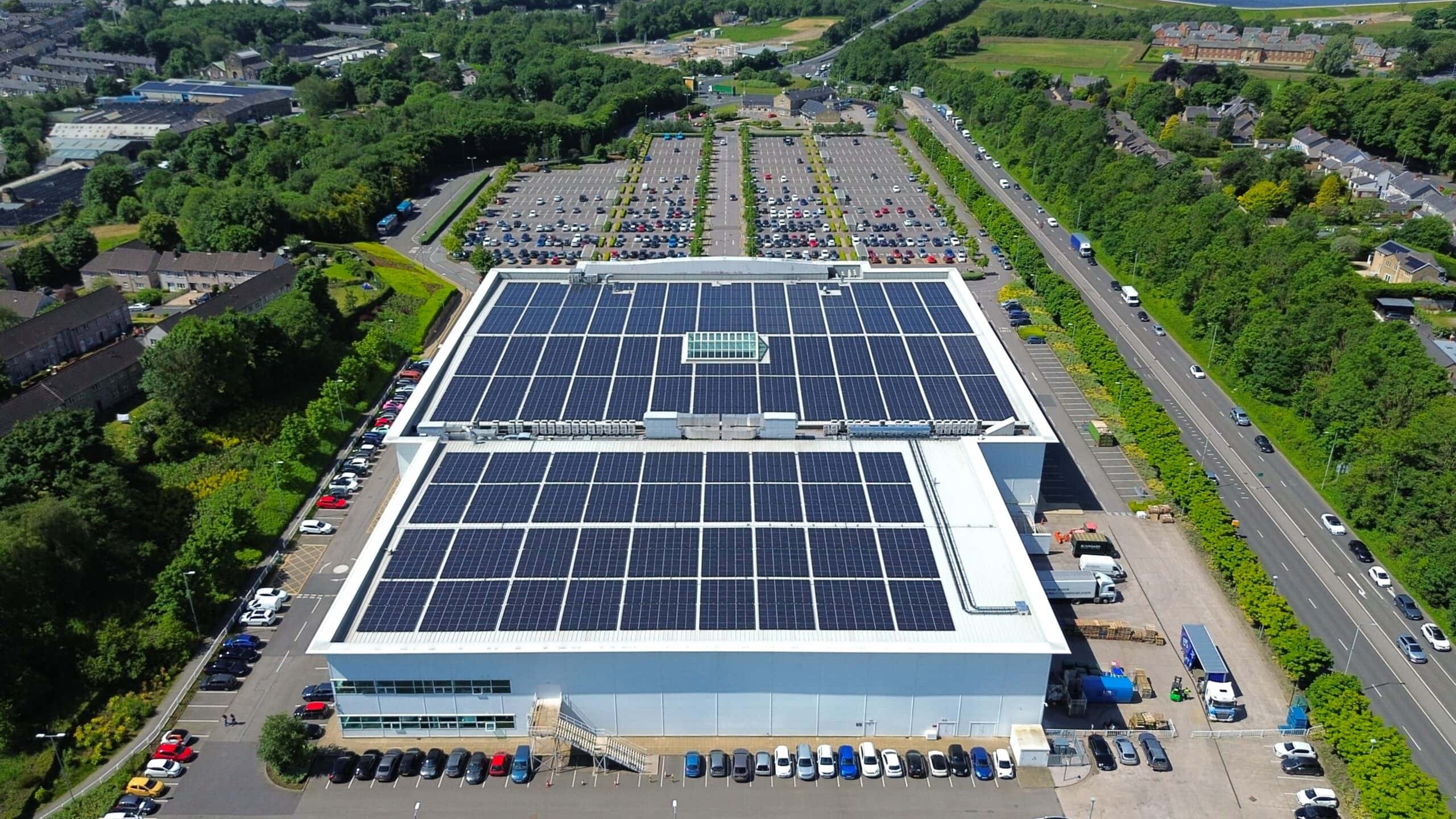
The good news is that many commercial buildings across Burnley, Lancashire, the North West and the wider UK are excellent candidates for solar. Warehouses, factories, offices, agricultural buildings, retail units and distribution centres often provide large, unobstructed roof space that can be used to generate clean, renewable electricity on-site.
At Activ8 Energies UK, formerly Low Carbon Energy and backed by SSE, we’ve delivered commercial solar projects for organisations ranging from manufacturing facilities and logistics companies to airports and national brands. Every project starts with one thing – understanding whether your building is suitable.
From industrial businesses in Blackburn and Preston to larger commercial sites across the North West, the right solar solution depends on much more than the size of your roof.
This guide explains what makes a commercial roof suitable for solar, what our engineers assess during a survey, the planning considerations involved, and what options are available if your roof isn’t suitable.
Why Your Roof Matters
Your roof is the foundation of every commercial solar installation.
A properly designed commercial solar PV system can help businesses:
- Reduce business electricity bills with solar
- Generate renewable electricity on-site
- Improve long-term energy security
- Lower carbon emissions
- Meet ESG and Net Zero objectives
- Achieve an excellent return on investment
However, no two commercial roofs are the same. Age, construction, orientation and structural capacity all influence system design.
For businesses considering solar panels for their business, assessing the building properly before installation is essential.
What Types of Commercial Buildings Are Suitable?
One of the biggest misconceptions is that solar is only suitable for modern industrial buildings.
In reality, commercial solar panels can be installed on a huge variety of properties across Burnley, Lancashire and the wider North West.
These include:
- Manufacturing facilities
- Industrial units
- Warehouses
- Distribution centres
- Food production facilities
- Agricultural buildings
- Farms
- Office buildings
- Retail parks
- Hotels
- Healthcare facilities
- Educational buildings
Whether you’re looking for factory solar panels in Lancashire, warehouse solar panels, or office solar panels, the first step is always a professional feasibility assessment.
The suitability of the site will depend on factors including the roof structure, available space, electricity usage, existing electrical infrastructure and the building’s future requirements.
What We Assess During a Commercial Roof Survey
Every building is different, which is why Activ8 never adopts a one-size-fits-all approach.
Our team looks beyond simply measuring the available roof area. A commercial solar assessment considers the building itself, how it uses electricity and how a solar PV system can work alongside the business’s existing energy infrastructure.
Our engineers assess several important factors before recommending a system.
Roof Structure
The first consideration is structural integrity.
Commercial solar panels are surprisingly lightweight, but the roof must safely support:
- Solar panels
- Mounting systems
- Wind loading
- Snow loading
- Maintenance access
Where required, structural engineers will verify the roof’s load-bearing capacity before installation begins.
This assessment is particularly important for older commercial and industrial buildings, where the original roof design may not have anticipated the addition of a modern solar PV system.
Roof Condition
If a roof is approaching the end of its lifespan, replacing or refurbishing it before installing solar often makes financial sense.
A solar PV system is designed to operate for decades, so installing onto a roof requiring replacement in a few years could create unnecessary costs later.
Assessing the roof condition at the beginning of the project helps businesses make a more informed decision about the timing of both roof works and solar installation.
Roof Orientation
South-facing roofs typically generate the highest output.
However, east-west roof layouts have become increasingly popular for commercial solar energy because they can spread electricity generation throughout the working day.
Even north-facing roofs may still contribute depending on roof pitch, site conditions and the overall system design.
Roof Pitch
Commercial solar panels can be installed on:
- Flat roofs
- Low-pitch roofs
- Metal sheet roofs
- Standing seam roofs
- Fibre cement roofs
- Pitched commercial roofs
Each roof type uses different fixing systems designed to maximise performance while protecting the building fabric.
Shading
Nearby buildings, trees, plant equipment or rooftop structures may create shading.
Modern design software identifies these obstacles early, allowing engineers to optimise panel placement and maximise energy generation.
For larger commercial sites, this assessment can make a significant difference to the final system design and expected generation.
Available Roof Space
Larger roofs generally allow for larger systems.
This is one reason why solar panels for warehouses, industrial units and manufacturing businesses continue to provide significant opportunities for on-site energy generation.
However, the biggest possible system isn’t necessarily the right system.
A properly designed commercial solar installation considers the amount of electricity a business uses, when that electricity is consumed and how much of the solar generation can be used on-site.
Flat Roof vs Pitched Roof
Many businesses assume pitched roofs are always better.
In reality, both offer advantages.
Flat Roofs
Flat roofs are extremely common across industrial estates and commercial developments throughout Lancashire.
Advantages include:
- Flexible panel orientation
- Easy maintenance access
- Excellent scalability
- Suitable for battery storage integration
Pitched Roofs
Pitched roofs often provide:
- Excellent drainage
- Strong structural support
- High energy generation
- Lower visual impact
Both roof types can support high-performing commercial solar panel installations when designed correctly.
What About Planning Permission?
Planning requirements depend on the type and location of your commercial solar project.
For many commercial rooftop solar PV installations, permitted development rights may apply, meaning a full planning application is not normally required. However, depending on the project and site, a 56-day prior notification or prior approval process may be required with the Local Planning Authority (LPA).
This is different from a full planning application and allows the LPA to consider the proposed works against the relevant planning requirements.
Ground-mounted solar and solar carports or canopies are more commonly subject to full planning applications.
Activ8 has extensive experience managing planning requirements as part of commercial solar projects, helping businesses understand what is required before installation begins.
What If My Roof Isn’t Suitable?
Not every roof is ideal.
Fortunately, that doesn’t necessarily rule out solar.
Alternative options include:
- Ground-mounted solar panels
- Car park solar canopies
- Roof strengthening works
- Partial roof installations
- Battery storage integration
- Future roof replacement with solar included
For some businesses, a ground-mounted system or solar carport may provide an alternative where roof space is limited or unsuitable.
Activ8 designs bespoke systems around each site’s specific requirements rather than forcing a standard solution.
Do Older Commercial Buildings Qualify?
Absolutely.
Many commercial properties across Lancashire and the North West were constructed decades ago.
Provided the structure remains sound, many older buildings can be excellent candidates for commercial roof solar panels.
A professional survey quickly determines suitability.
The age of the building alone doesn’t determine whether solar is possible. Roof construction, condition, structural capacity, electrical infrastructure and the site’s energy requirements all need to be considered.
Can Solar Damage My Roof?
When installed correctly by experienced commercial solar installers in Lancashire, the answer is no.
Professional installation systems are specifically engineered to protect the roof while maintaining waterproofing and structural integrity.
Poor installation—not solar panels themselves—is what causes issues.
This is why choosing an experienced commercial solar installation company in Lancashire is so important.
A properly planned project should consider the roof condition, fixing method, drainage, access and maintenance requirements before installation begins.
What About Battery Storage?
Increasingly, businesses are combining commercial solar panels with commercial battery storage.
Battery storage allows organisations to:
- Store excess solar electricity
- Reduce peak electricity costs
- Improve energy resilience
- Increase solar self-consumption
- Reduce reliance on the National Grid
For businesses operating long hours, business battery storage can significantly improve the value of a commercial solar system by allowing more of the electricity generated during the day to be used when it is needed.
Battery storage can also provide an additional layer of energy resilience.
For energy-intensive businesses, unexpected interruptions to electricity supplies can cause significant disruption to manufacturing, processing and other critical operations. On-site energy generation combined with battery storage can give businesses greater flexibility in how they manage their energy and respond to changing demand.
Depending on the system and market arrangements, battery storage can also create opportunities to participate in grid flexibility and capacity markets, potentially providing an additional revenue stream alongside the savings generated by solar and battery storage.
For businesses where energy security and operational continuity are critical, solar and battery storage can therefore form part of a wider strategy for managing both energy costs and resilience.
Why Warehouses and Industrial Buildings Are Perfect for Solar
Large industrial roofs remain some of the best locations for solar generation.
Businesses operating:
- Warehouses
- Manufacturing facilities
- Food production sites
- Distribution centres
- Agricultural buildings
often consume large amounts of electricity during daylight hours—exactly when solar panels generate the most power.
This can create an excellent opportunity to use more renewable electricity directly on-site while reducing reliance on electricity purchased from the grid.
For businesses with significant daytime electricity demand, the combination of a large roof and consistent energy consumption can make commercial solar particularly attractive.
Why Choose Activ8 Energies?
Formerly Low Carbon Energy, Activ8 Energies UK has become one of the UK’s leading providers of commercial solar panels, delivering bespoke renewable energy solutions backed by more than two decades of industry expertise.
Operating from Burnley and serving businesses across Lancashire, North West England and the wider UK, our experienced team manages every stage of your project—from feasibility studies and system design through to installation, monitoring, maintenance and ongoing support.
Our commercial services include:
- Commercial Solar Panel Installation
- Commercial Battery Storage
- Solar & Battery Storage Solutions
- Solar Panel Maintenance for Businesses
- Commercial Solar Panel Servicing
- Commercial Solar Panel Repairs
- EV Charging for Businesses
- Commercial EV Charger Installation
- Fully Funded Solar Solutions
- Power Purchase Agreements (PPAs)
Whether you’re investing through CapEx or exploring fully funded options, we deliver renewable energy systems designed around your operational needs—not a standard package.
Find Out If Your Roof Is Suitable
If you’re considering commercial solar panels in Lancashire, Burnley or anywhere across the North West and wider UK, the first step is a professional site assessment.
At Activ8 Energies, we evaluate your roof structure, electricity usage, available space, existing infrastructure and long-term business goals before designing a bespoke solar solution that delivers measurable savings and long-term value.
Whether you’re looking for business solar panels, commercial solar PV, factory solar panels, warehouse solar panels or complete commercial renewable energy solutions, our team is here to help.
From businesses across Lancashire and the North West to larger commercial projects elsewhere in the UK, we can assess your site and identify the most appropriate renewable energy solution for your organisation.
Book a free commercial solar assessment today and discover how your roof could become one of your business’s most valuable assets.